Contents
Arriving and signing up
First contact happens at the camp’s front desk, or in writing before you come. What you say that day helps the trainer adapt the exercises: be precise.
- Bring the camp’s exact address and the written confirmation of what you booked: plan, price, what is included.
- State your level without dressing it up: never trained, a few classes, regular practice.
- Mention any injury or pain, even an old one, before the first session.
- Ask what the camp lends or rents (gloves, shin pads) before buying.
- Turn up dressed for training, in a T-shirt, not in beachwear: a custom published by Sumalee.
What to pack, what to buy there
How the first session goes
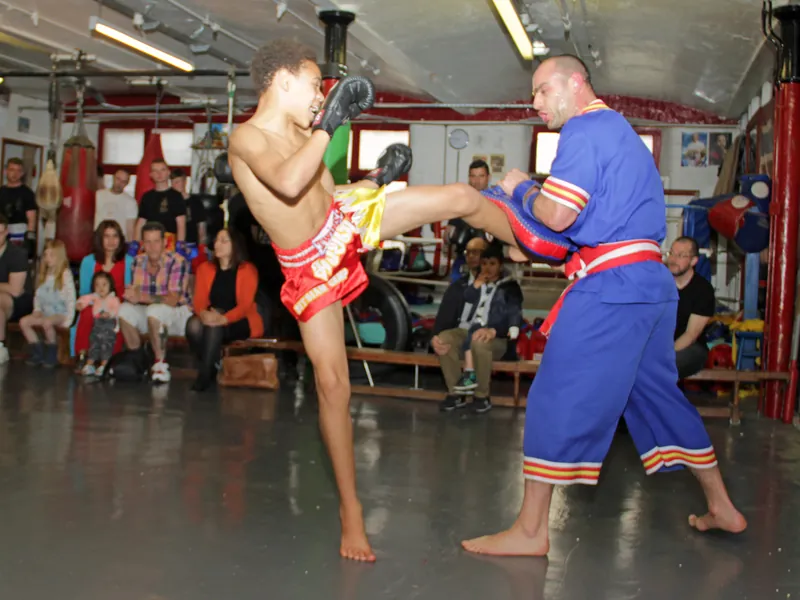
Content varies from camp to camp. The most common routine chains warm-up, shadow boxing, pads, bag work, technique and conditioning.
The warm-up
It prepares your joints and breathing. Follow the group’s pace without forcing: the session is not won or lost here.
The pads
Pad work, facing a trainer, is the heart of the session. At Sinbi (Phuket) it is included in every class, as 5 × 3 rounds. Elsewhere the number of rounds is not published: ask.
Sparring: light, or not at all
Sparring is not automatic on day one. Sumalee describes sparring as light and technical by default, with intensity never improvised. If you are a beginner, say so and ask for it to be supervised or postponed.
Schedule, rest and Sunday
Only three camps in our directory publish their schedule on their official page. For the others we have no timetable: ask the camp.
| Camp | City | Published schedule |
|---|---|---|
| Sinbi Muay Thai | Phuket | 2 sessions a day, Monday to Saturday |
| Santai Muay Thai Gym | Chiang Mai | 2 sessions a day, Monday to Saturday |
| Diamond Muay Thai | Koh Phangan | 2 sessions a day, Monday to Saturday; a 1-session-a-day plan is also published |
- Sunday is not listed as a training day by these three camps: keep it for recovery.
- For the first days, one session a day is enough while your body adapts.
- Skipping a session when your body asks is better than an injury.
- Sleep, eat and drink regularly: the health and safety guide covers the heat.
Etiquette: customs in the gym and the ring
The customs below come from the etiquette page published by Sumalee camp (Phuket). They vary from camp to camp: when unsure, watch the others and ask.
- Greet the kru (the teacher) with a wai, palms together, before and after training.
- Never step over the ring rope: go under it.
- Do not touch anyone’s head: it is the most sacred part of the body.
- Do not point your feet at a person or at an image of the Buddha.
- Take your shoes off before stepping onto the mat.
- Come clean, with clean gear: you train in close contact with others. Put gloves and pads away after use.
- In sparring, stay light and technical; intensity is decided with the trainer.
- Treat the Thai trainers as teachers, not as service staff.
The wai kru and the mongkon, in the ring
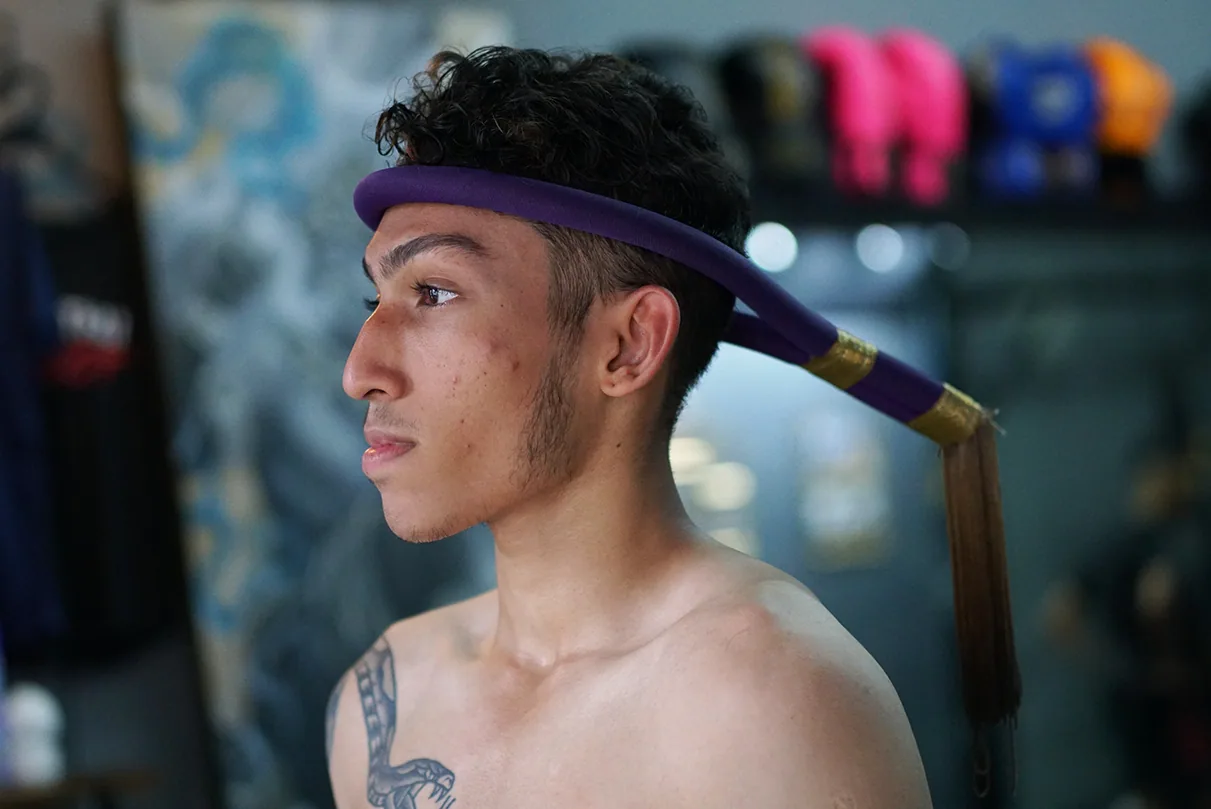
The IFMA rules (the international federation) define the wai kru as a traditional ritual performed before competition as a sign of respect. They require the fighter to bow three times on the canvas wearing the mongkon, and to enter the ring between the second and third ropes.
Under the WBC MuayThai rules, the mongkon is worn only for the pre-fight tribute (wai kru, ram muay); during the bout only the armband (prajiad) may stay on, and it is removed if it gets in the way. The WBC states that the wai kru and ram muay are not religious but a cultural art form specific to the sport and culture of Muay Thai.
- Bows on the canvas, mongkon on the head (IFMA rules)
- 3
- Ropes between which you enter the ring (IFMA rules)
- 2nd and 3rd
- Ropes around an official ring (IFMA, WBC)
- 4
Vocabulary: 16 words for the gym
Greetings, numbers and times of day come from the Wikivoyage Thai phrasebook; ring terms come from the IFMA and WBC rules. For those we give the transcription only: their Thai spelling is not recorded in our sources.
- สวัสดีsa-wat-dii
- Hello
- ขอบคุณkhop khun
- Thank you
- ครับkhráp
- Polite particle at the end of a sentence, used by men
- ค่ะkhâ
- Polite particle at the end of a sentence, used by women
- หนึ่งnueng
- One (1)
- สองsong
- Two (2)
- สามsaam
- Three (3)
- สี่sii
- Four (4)
- ห้าhaa
- Five (5)
- เช้าcháo
- Morning
- เย็นyen
- Late in the day
- kru
- The teacher, the trainer
- wai kru
- The tribute to the teacher, before a fight
- ram muay
- The ritual dance
- mongkon
- The headband worn for the wai kru
- nak muay
- A Muay Thai practitioner
To thank the kru after the session: khop khun, followed by khráp if you are a man, khâ if you are a woman.
Frequently asked questions
Do I need to speak Thai to train?
No. A few words help: sa-wat-dii to greet, khop khun to thank, followed by khráp or khâ. This guide’s vocabulary list gives 16.
Is sparring compulsory on day one?
Our sources do not say so for any camp. Sumalee describes sparring as light and technical by default. State your level and ask the camp when it starts.
How many sessions a day?
Sinbi, Santai and Diamond publish two sessions a day, Monday to Saturday. For other camps, ask. For the first days, one session a day is enough.
Is the wai kru a religious rite?
According to the WBC MuayThai rules, no: it is a cultural art form specific to the sport and culture of Muay Thai.
Next step
Sources
Checked on
- Sumalee Boxing Gym — Muay Thai Etiquette (14/07/2025)
- IFMA — Rules & Regulations for International Competition, v3.057 (11/05/2026)
- WBC MuayThai — règles officielles
- Wikivoyage — Thai phrasebook (CC BY-SA)
- Sinbi Muay Thai — tarifs et rythme
- Santai Muay Thai Gym — tarifs et rythme
- Diamond Muay Thai — tarifs et rythme